The NEPHELE project, a European initiative focused on developing next-generation solutions for Edge-to-Cloud Continuum management, officially concluded on September 30, 2025, after successfully meeting its objectives.
The final review meeting with the European Commission took place online on December 1, 2025, and the results were highly positive. Both the Project Officer from DG CONNECT and the external reviewers expressed great satisfaction with the consortium’s achievements.
According to the reviewers "The consortium has performed an excellent work" throughout the project’s duration. They highlighted "the good job performed in the integration" of the different components developed by the consortium. R&D Spain played a crucial role on this integration task, not only as contributors on NEPHELE Synergetic MetaOrchestrator (SMO) but also as the creators of the NEPHELE Development Environment which plays an essential role on the NEPHELE Framework. This component is responsible for architecture interactions with all other modules, as it facilitates and automates the process of creating and validating artifacts, such as OCI (Open Container Initiative) artifacts, Helm charts, Docker images, VNFs (Virtual Networks Functions), or customizable artifacts like virtual objects that represent edge devices, as well as HDA (Hyper Distributed Applications) graph descriptors, to enable the SMO to place services efficiently, thereby providing a common layer for the Cloud–Edge–IoT continuum. (Read more about this asset in NEPHELE website.)
The reviewers were also particularly "impressed by dissemination and communication", recognizing the significant impact of the project's outreach activities. This success in communication, but also in the definition of future exploitation plans and the features that make the project assets unique was greatly supported by the critical role played by Eviden, which coordinated one of the key tasks within the dedicated work package.
Project Summary and Use Cases
The NEPHELE project's vision was to enable the efficient, reliable, and secure end-to-end orchestration of distributed applications over programmable infrastructure spanning the compute continuum from Cloud-to-Edge-to-IoT. A key goal was the elimination of existing barriers to openness and interoperability. Key innovations included:
- Virtual Object Stack (VOStack): An IoT and edge computing software stack (VOStack) for leveraging virtualization of IoT devices at the edge and supporting openness and interoperability aspects in a device-independent way
- Synergetic Meta-Orchestration Framework: A framework for managing distributed applications in the compute continuum based on the adoption of a “system of systems” approach.
The project's outcomes were successfully demonstrated in use cases across various vertical industries, including areas such as disaster management, logistic operations in ports, energy management in smart buildings, and remote healthcare services. The project has also managed two Open Calls - the first focused in the creation of new Virtual Objects and the second on Orchestration Platform and Distributed Applications management) in which the 16 funded projects helped to validate the NEPHELE platform, and provided feedback and business value identification from various verticals.
Learn more about NEPHELE use cases, (with videos), NEPHELE 1st Open Call results (with videos) and NEPHELE 2nd Open Call Results (with videos)
MetaOS ecosystem
NEPHELE is part of the MetaOS ecosystem, a cluster of projects funded by the European Commission under the Horizon Europe programme to design the future European platforms for the Edge and to jointly exploit results and create synergies, maximizing impacts of the Cloud-Edge-IoT portfolio. Other projects in this cluster are aeROS, FluiDOS, ICOS, NebulOuS, NEMO and the CSAs Open Continuum and Unlock-CEi (both under the umbrella of EUCloudEdgeIoT.eu). Having contributed to 4 out of the 8 projects within this ecosystem, R&D Spain holds now a key position in the future of the MetaOS market opportunities.
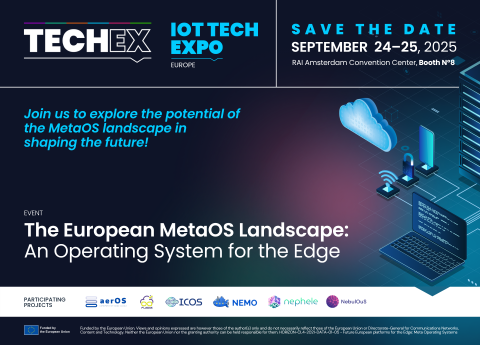
To learn more about the future perspectives for the MetaOS ecosytem, read this article about the session of "The European MetaOS Landscape – An Operating System for the Edge" at the IoT Tech Expo 2025.